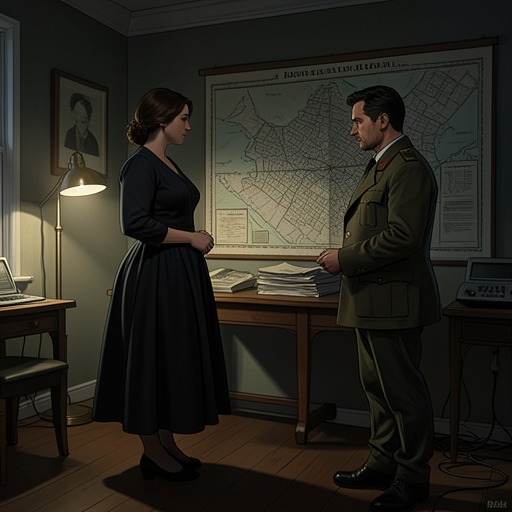
Flynne Fisher's peripheral embodiment
The PeripheralFlynne Fisher’s peripheral embodiment is her remote inhabitation of an anthropomorphic drone in a future London. It begins as a piece of hardware and a supposed game controller, then becomes a bodily encounter: Flynne opens her eyes in another body, feels its altered scale and senses, and must learn that her own reactions do not all belong to the machine she is inhabiting. The experience makes telepresence more than a screen-mediated view; it is a way to act in a future that is connected to, but no longer identical with, her own world.
Device and First Contact
The connection first reaches Flynne as an unexplained technical proposition. The people arranging it describe what they are sending only as a piece of hardware and offer generous payment for arranging it, without being able to explain what it does. When the device is presented to her, Flynne objects that she had been told it was a game controller. The correction—“Telepresent interface, no hands.”—recasts it as a means of presence rather than play. Its operation depends on contact at the forehead, with saline mentioned as part of setting it up.
That distinction matters because Flynne is not simply looking at a remote scene. Once the interface works, the unfamiliar view is attached to a body with its own height, face, voice, and physical limits. The device is imperfect, but Ash says it works; Flynne’s first exposure makes that modest assessment feel radically inadequate to the scale of the change.
Entering the Peripheral
Flynne agrees to begin only when she says go. She counts down with her eyes closed, but at first nothing seems to happen. A pop and a strange color sensation—like Burton’s haptics scar, but somehow tasted inside her teeth—offer no clear confirmation that the connection has succeeded. As she reaches zero and opens her eyes, the room seems to turn over: the ceiling is suddenly higher, polished, and six feet above the one in the trailer; the direction of the room feels reversed, and the crown’s weight is gone. Her stomach feels upside down.
The decisive discovery is her own hands. Flynne does not remember sitting up, yet sees hands that are hers in the sense that she can use them and not hers in appearance. A steel canister held out by a woman gives her a polished surface in which to see a face that is not her own. She freezes, then rises quickly from what she realizes is a padded ledge rather than a bed. She is taller, and the voice she hears speaking is not her familiar voice. The sequence makes the transfer legible through discrepancies in bodily orientation, height, face, and sound before anyone can offer a technical explanation.
Ash supplies that explanation: Flynne is receiving input from an anthropomorphic drone, a telepresence avatar, and need not consciously control it. She warns her not to try as the device is recalibrated. Flynne’s first response is not mastery but disorientation; the practical work of recalibration follows an experience that has already unsettled her sense of where she is.
Sensation, Expression, and Limits
The new body does not reproduce Flynne’s entire physical life. When Flynne says she is starving, Ash identifies the sensation as autonomic bleed-over: the hunger belongs to Flynne’s own body, not the peripheral. The peripheral does not eat and has no digestive tract. Yet the separation is not total sensory blankness. Ash asks whether Flynne can smell the flowers, and Flynne nods. Hunger and smell thus mark different relations between the remote body and its operator: one sensation crosses over from her original body, while another is available through the peripheral.
Flynne also gives the machine a distinct quality of movement and expression. Netherton observes that she completely alters the peripheral’s body language as Ash directs her toward him. Its face becomes not Flynne’s face, but somehow her. Ash had explained that an AI-controlled peripheral looks human because its face continually registers changing micro-expressions; without that activity, the machine becomes uniquely disturbing. With Flynne inhabiting it, her own micro-expressions replace the artificial performance. The result unsettles Netherton: he backs down the narrow corridor, unable to turn his back or stop watching, and experiences the sight as something like an unthinkable birth or advent. His reaction underscores that the peripheral is neither simply a person-shaped machine nor a neutral tool once Flynne’s embodied habits animate it.
The separation between operator and avatar remains visible even in ordinary exchanges. Flynne can smell flowers and speak through a voice that sounds unlike her own, while her hunger belongs to the body elsewhere. These mismatches make the connection neither a perfect copy of physical life nor a clean escape from it. Her own body continues to assert itself inside an encounter whose immediate surroundings and visible body are elsewhere.
Learning the Interface and Its World
Flynne’s familiarity with remote services provides one point of comparison. When Lev remarks that she is used to telepresence, she explains that in her world people call it getting a haircut: a stylist named Carlota, in the Marianas, works through a bot chair at their Hefty Clips and keeps up with the styles. The casual example makes the future interface less like an incomprehensible miracle and more like an extension of an existing service economy. But a haircut arranged remotely is not the same as waking inside an anthropomorphic body. Flynne’s frontier-days joke also places the contrast in time: familiar telepresence in her world sits beside a far more intimate and consequential form in theirs.
The connection is used to bring her back into the future setting, where she opens her eyes on the peripheral reclining on a bunk in the back cabin. Ash has arranged the lights and the body’s position; Flynne tests the experience tentatively and says it is not bad. Lev welcomes her back. The scene presents return as a repeated passage rather than a single discovery: the avatar can be reclined, prepared, and entered again, while those around Flynne recognize the reopening of the connection as her return.
The technology does not make the future an unchanged destination. Flynne explains that the people speaking to her call it a future, not exactly hers, because their first contact has already changed where her world is headed. They exchange information rather than travel through time in the familiar sense, and time proceeds in parallel: a minute later on one side is a minute later on the other; a week spent before returning corresponds to a week there. Her peripheral embodiment therefore brings an additional problem into view. Flynne can enter the future, but the connection itself participates in the divergence between the two worlds.
Cooperation and Significance
The peripheral is also a working interface between people who do not share a single technical vocabulary or level of understanding. The hardware arrives without an adequate explanation; Flynne calls it a game controller before learning it is a telepresent interface; Ash, who knows Macon virtually, helps recalibrate it; and Lev and Netherton witness Flynne’s presence through its visible body. The same device is therefore hardware, a supposed game, a remote body, and a means of contact across different worlds. Its use depends not only on the apparatus but on explanation, adjustment, and the operator’s ability to interpret sensations the machine cannot make self-evident.
The arrangement later becomes part of Flynne’s practical role in events surrounding Burton. She tells someone that she is there to help Burton and, in a qualified way, the speaker as well, although Jackman had not mentioned that person. The remark places her in a network of assistance that the connection makes possible without making her presence in the future an official or uncomplicated one.
At Sushi Barn, the chapter heading “SUSHI BARN” leads into a physical route assembled through the vacant spaces beside Coldiron: walls of shingle bags form a walkway from a hole in one wall, across empty stores, and through another opening into Hong’s kitchen. The episode locates the broader world of the technology amid improvised passageways and real danger, rather than treating remote embodiment as a self-contained marvel. Across these contexts, the peripheral’s importance lies in what it lets Flynne do and perceive—and in the persistent friction between her original body, the artificial body she inhabits, and the future her presence helps alter.